Ever found yourself in a scheduling pickle trying to convert Pacific Time to Eastern Time? You’re not alone. Whether it’s a crucial business meeting or catching your favorite show, time zones can feel like an elaborate game of hopscotch. One minute you’re basking in the California sun, and the next, you’re late for dinner in New York!
Understanding Time Zones
Pacific Time (PT) is three hours behind Eastern Time (ET). When planning events across these zones, awareness of the time difference becomes crucial. For instance, a meeting scheduled at 10 AM PT occurs at 1 PM ET.
Navigating these time zones involves knowing their standard times and daylight savings adjustments. PT applies to states like California and Washington, while ET covers areas such as New York and Florida. Seasonal time changes can further complicate scheduling; both zones shift to daylight savings time, impacting the overall time difference.
Visualizing the time difference aids understanding. A simple way is to think about a clock. If the clock shows 12 PM in New York, it shows 9 AM in Los Angeles. Many tools exist for converting these times, including smartphone applications and online converters.
Scheduling becomes easier with some practices. Always double-check the time zone when arranging calls or meetings. Mark your calendar with the correct time zone, and include both PT and ET for clarity. This practice prevents confusion, especially during events involving participants from both coasts.
Understanding the relationship between time zones reduces the chances of missing critical engagements. Regularly checking time differences is handy for those who frequently travel or communicate across these borders. Keeping a time zone chart nearby can also simplify matters, ensuring smooth transitions between Pacific Time and Eastern Time.
Conversion Between Pacific Time and Eastern Time
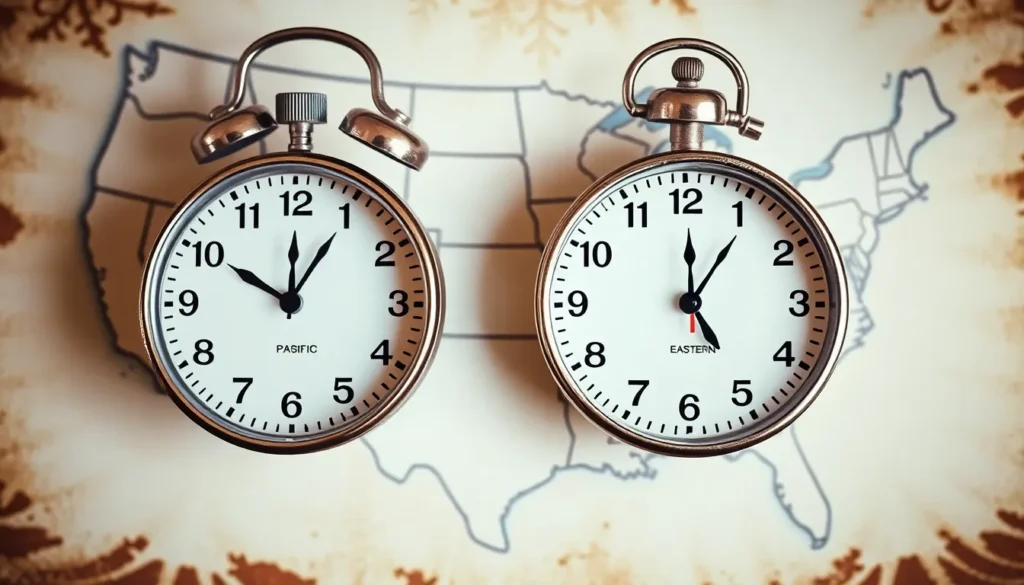
Understanding the conversion between Pacific Time (PT) and Eastern Time (ET) enhances scheduling for users across these zones. Transitioning from PT to ET requires a straightforward three-hour addition.
Step-by-Step Conversion
- Identify the current time in Pacific Time.
- Add three hours to convert to Eastern Time.
- Adjust for daylight saving when applicable.
For instance, if it’s 2:00 PM PT, adding three hours results in 5:00 PM ET. Always check if both regions observe daylight saving time to ensure accuracy.
Real-World Examples
Scheduling a business meeting across time zones exemplifies the importance of accurate conversions. If a meeting is set for 10:00 AM PT, it corresponds to 1:00 PM ET. Television show air times also highlight this conversion; for example, a show airing at 8:00 PM ET starts at 5:00 PM PT. Keeping these conversions in mind helps avoid confusion and ensures timely participation in events.
Importance of Knowing Time Differences
Understanding time differences plays a crucial role in various aspects of daily life, particularly in business and travel.
Impact on Business and Communication
Time differences directly affect meeting schedules and communication efforts. Scheduling a call across time zones often requires careful planning. For instance, a meeting set for 10:00 AM PT lands at 1:00 PM ET, highlighting the need for accuracy. Miscommunication can occur easily without attention to these details. Officials working in different regions benefit from coordinating their availability based on local time. Remote teams thrive with tools that display multiple time zones, preventing misunderstandings. Precision in timing fosters smoother interactions and productivity in businesses operating across the Pacific and Eastern time zones.
Travel Considerations
Travelers moving between Pacific and Eastern time zones face unique challenges. Adjusting to a three-hour difference can impact activities such as meetings, sightseeing, and flight arrivals. Many tourists overlook this factor, leading to missed appointments or events. Understanding local time helps travelers plan their itineraries effectively. Jet lag affects energy levels and schedules, emphasizing the importance of time awareness during travel. Coordinates such as flight departure times must align with local time zones to prevent confusion. Using travel apps that feature time zone converters eases transitions and enhances the travel experience significantly.
Tools for Time Conversion
Various tools assist in converting Pacific Time (PT) to Eastern Time (ET). Online converters provide quick results, requiring just input of the current PT time. Smartphone applications enhance accessibility, offering features like notifications for time zone changes.
Time zone charts serve as handy references. Users can visualize the three-hour difference at a glance. Many devices automatically adjust for daylight savings, keeping schedules accurate.
Calendar applications also integrate time zone conversion. Setting an event in PT automatically converts to ET for invited attendees. This feature reduces confusion while scheduling meetings or events.
Some websites allow for customized conversions. They enable users to select specific times and dates for precise calculations. These platforms are particularly useful for planning future engagements.
Collaboration tools prove beneficial for remote teams. They often display multiple time zones side-by-side. This display fosters better communication and coordination among members situated across different regions.
Planning travel itineraries becomes seamless with dedicated travel apps. Many of these apps feature built-in time zone converters, simplifying the adjustment process. Users experience reduced stress when monitoring flight schedules along PT and ET.
Overall, utilizing a mix of these tools ensures effective time management. Familiarity with various options equips individuals to handle time conversions confidently. Being proactive in employing these resources enhances scheduling efforts significantly.
Navigating the time difference between Pacific Time and Eastern Time is essential for effective scheduling. Understanding the three-hour gap can prevent confusion during important meetings or events. The use of various tools like online converters and smartphone applications makes this task easier and more efficient.
For those frequently traveling or communicating across these time zones, keeping a time zone chart handy can be a game changer. By incorporating these strategies into daily routines, individuals can enhance productivity and ensure they never miss a crucial engagement. With a little preparation and awareness, managing time differences becomes a straightforward process.