Imagine flipping through a dusty old book and stumbling upon wild predictions about the future. From flying cars to robot butlers, past visionaries had some pretty ambitious ideas. But how many of those predictions actually came true? It’s a fascinating journey to explore what people thought the future would hold and how their imaginations shaped our reality today.
Overview of Future Predictions
Reflection on historical predictions about the future reveals the ambitious projections made by past visionaries. Those predictions illustrate the interplay between imagination and our current reality.
Importance of Analyzing Predictions
Analyzing predictions plays a crucial role in understanding societal progress. Evaluating past forecasts provides insight into human creativity and technological advancement. Assessment of these predictions helps identify patterns in innovation. Recognition of successes and failures informs future endeavors. Critical examination leads to better forecasting and planning for upcoming challenges.
Historical Context
Historical context influences how predictions shape society. Various eras embraced different technological capabilities, impacting the nature of predictions. The Industrial Revolution sparked hopes for mechanization, while the 20th century envisioned space exploration and automation. Understanding the circumstances surrounding these predictions helps clarify their significance. Each prediction reveals insights into cultural aspirations and concerns. Knowledge of past contexts fosters a deeper appreciation for contemporary advancements.
Notable Predictions from the Past
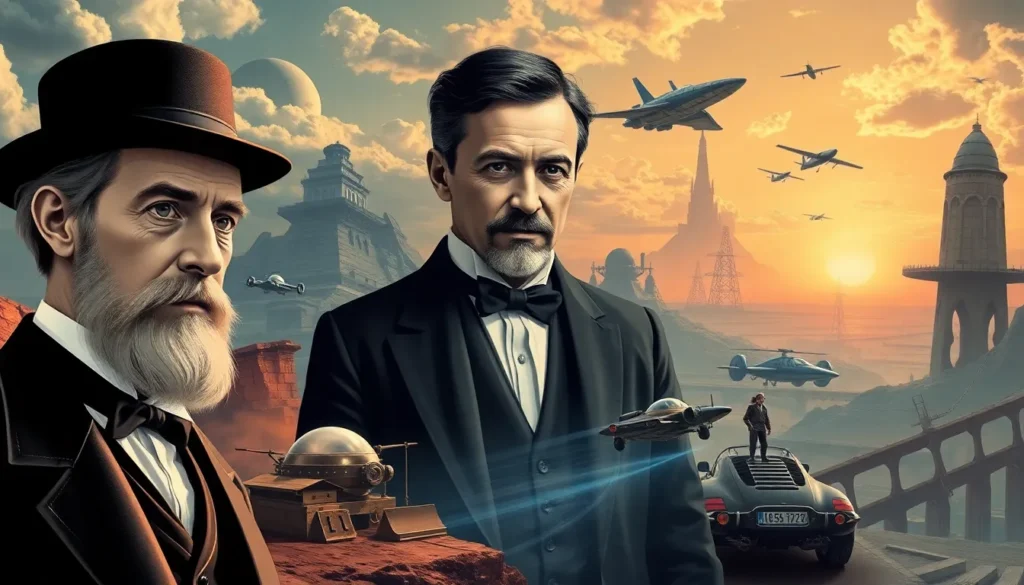
Historical predictions reflect the hopes and visions of past thinkers. They offer a fascinating glimpse into human creativity and the evolution of technology.
Predictions in Literature
Many writers envisioned future innovations through their stories. Jules Verne, a pioneer in speculative fiction, predicted submarines and space travel, both realized in the 20th century. H.G. Wells imagined time machines and advanced robotics, ideas that continue to inspire today. Other authors, like George Orwell, depicted dystopian futures marked by surveillance, foreshadowing contemporary discussions around privacy. Literature often mirrors societal concerns and aspirations, showcasing the power of imagination in shaping technological discourse.
Predictions in Science and Technology
Scientists and inventors also made significant predictions about future advancements. Nikola Tesla envisioned wireless communication, which became reality with the rise of smartphones. Alan Turing’s concepts of computing paved the way for artificial intelligence developments. In 1965, Gordon Moore predicted the doubling of transistors on chips approximately every two years, leading to exponential growth in computing power. Such forecasts reveal a consistent trajectory in technological evolution, demonstrating how visionary thinking laid the groundwork for innovation.
Accuracy of Past Predictions
Evaluating the accuracy of historical predictions sheds light on human creativity and foresight. Some predictions remarkably align with current realities.
Examples of Accurate Predictions
Jules Verne envisioned submarines in his 1870 novel, “Twenty Thousand Leagues Under the Sea.” His fictional creations later led to real underwater exploration technologies. H.G. Wells forecasted advancements in robotics, which have manifested in modern automation and artificial intelligence. Nikola Tesla predicted wireless technology, a concept realized through today’s smartphones and internet connectivity. Each of these forecasts exemplifies how visionary thinking influenced technological development and societal change.
Examples of False Predictions
Numerous past predictions failed to materialize, highlighting the unpredictability of progress. Popular among these was the 1950s forecast that everyone would have flying cars by the year 2000. Analysts also mistakenly believed that computers would never surpass human intelligence. In literature, George Orwell’s prediction of a wholly surveilled society sparked concern, yet today, much of it remains unfulfilled. Each example serves as a reminder that while visions inspire innovation, they often miss the mark due to changing societal and technological dynamics.
Influence on Modern Thinking
Historical predictions influence contemporary thought processes and inspire future innovations. Understanding how past forecasts shape current perspectives offers valuable insights.
How Predictions Shape Our Future
Predictions often guide technological directions and innovations. They motivate researchers and engineers by providing blueprints for potential advancements. Numerous inventions and discoveries originate from the visions of past thinkers, reflecting aspirations for a better world. For example, early computing concepts envisioned by Alan Turing laid the groundwork for today’s digital landscape. Encouragement arises as society continues to explore the realms these predictions opened up. The pursuit of flying cars hasn’t ceased entirely, as innovations in aviation technology emerge. By analyzing past forecasts, knowledge emerges that fuels creativity in diverse industries.
Lessons Learned from Past Predictions
Lessons derived from historical predictions inform present-day expectations. Embracing a mix of optimism and caution, people recognize that reality may differ from envisioned futures. Accurate predictions highlight humanity’s capability for innovation, while inaccurate ones serve as reminders about uncertainty. The expectation of flying cars by 2000 contrasts with the actual technological trajectory, showcasing the unpredictability of innovation. Acknowledging these discrepancies fosters resilience and adaptability. Evaluating the visions of authors like Jules Verne and George Orwell enriches contemporary understanding of societal aspirations and concerns. Insights gained from past forecasts encourage critical thinking about future possibilities.
Reflecting on past predictions reveals a fascinating interplay between imagination and reality. Visionaries have consistently shaped societal aspirations through their forecasts, whether accurate or not. These insights not only highlight the trajectory of human creativity but also serve as a reminder of the unpredictability of progress.
As technology continues to evolve, the lessons learned from historical predictions remain relevant. They inspire current innovators while encouraging a thoughtful approach to future possibilities. By understanding how past visions have influenced today’s advancements, society can better navigate the complexities of tomorrow’s technological landscape. Embracing both optimism and caution will be essential as humanity forges ahead into uncharted territories.